Monday, February 24, 2014

Top 100 & KC Connections: 71—80

71. Eddie Plank • P • 1901—1917

Appeared in three games in KC in 1915 with the St. Louis Terriers vs. the Kansas City Packers of the Federal League.

72.


73. Chipper Jones • 3B • 1993—2012

Made one appearance in KC at the tail end of his career in the 2012 All-Star Game. The crowd gave him a huge ovation as he came to bat for his one plate appearance, and Jones saluted with his helmet held high before squibbing a ground ball single.


74. Hank Greenberg • 1B • 1930—1947

75. Jackie Robinson • 2B • 1947—1956

Made his pro debut as the shortstop for the 1945 Monarchs.

76. Fergie Jenkins • P • 1965—1983

Fergie may not have enjoyed Royals Stadium: 12 starts, 1-5, 6.33 ERA.

77. Jeff Bagwell • 1B • 1991—2005

Played just nine games at Kauffman, but crushed three home runs and a 1.287 OPS.


78. Charlie Gehringer • 2B • 1924—1942

Played an exhibition against the Monarchs in KC in '35 as a member of the World Series All-Stars.

79. Rod Carew • 1B/2B • 1967—1985

41 games at Municipal Stadium, 76 at Royals Stadium.

80. Joe Jackson • LF • 1908—1920

Tuesday, February 11, 2014

Top 100 & KC Connections: 81—90

81. Buck Leonard • 1B • 1934—1953

As a member of the Homestead Grays between '34-'48, was a central player in the epic Grays vs. Monarchs battles of the '40s. For some reason it was usually the Monarchs heading east to face the Grays, but Leonard made at least a couple of trips to play in KC.

82. Arky Vaughan • SS • 1932—1948

May have appeared in an exhibition game against the Blues in 1942, though it was reported that several Dodgers regulars failed to play.

83. Mike Piazza • C • 1992—2007

Made one trip to Kauffman with the Mets in 2004 and DH'd all three games. Hit a dinger off Zack Greinke.

84. Ray Dandridge • 3B • 1933—1953

Good chance he traveled to Muehlebach/Ruppert (later Municipal) Stadium to play the Monarchs while he was in and out of the Negro leagues between '33-'44, and definitely came to play the Blues while with the Minneapolis Millers of the American Association between '49-'52.

85. Ron Santo • 3B • 1960—1974

Started the '73 All-Star Game at Royals Stadium.

86. Mike Mussina • P • 1991—2008

15 starts at Kauffman Stadium: 9-2, 3.04 ERA.

87. Roy Halladay • P • 1998—2013

Five starts at Kauffman Stadium: 3-1, 2.67 ERA.

88. Reggie Jackson • RF • 1967—1987

Drafted by the KC A's with the second pick of the 1966 draft, made his MLB debut in Kansas City on June 9, 1967. Played just 35 inauspicious games with the KC A's (.574 OPS) before the franchise moved to Oakland for the '68 season. As a career-long American Leaguer, he made a lot of trips back to KC to face the Royals. Played in 135 regular season games in KC (55 at Municipal, 80 at Royals). Did not hit especially well at Royals Stadium: .715 OPS there, compared to a career .846. Faced the Royals in the playoffs in '77, '78, and '80.

89.
Tied Johnny Bench's mark for home runs by a catcher at Royals Stadium on August 8, 1990 (with yours truly in attendance). Played five games at Municipal Stadium, 83 regular season games at Royals Stadium, and was the starting catcher at the 1973 All-Star Game in KC.

90. Ivan Rodriguez • C • 1991—2011

Cracked 12 homers and a .911 OPS in 90 games at Kauffman.

Tuesday, February 4, 2014

Top 100 & KC Connections: 91—100

91. Brooks Robinson • 3B • 1955—1977

A frequent visitor to KC with 138 games (115 at Municipal, 23 at Royals Stadium).

92. Larry Walker • RF • 1989—2005

Just three games at Kauffman Stadium, but managed two doubles and a ding-dong.

93. Pete Rose • IF/OF • 1963—1986

Played three games in KC during the '80 World Series and started in left field at Royals Stadium in the '73 All-Star Game.

94. Robin Yount • SS/CF • 1974—1993

94 games at Royals Stadium, where he had an .872 OPS.

95. Duke Snider • CF • 1947—1964

May or may not have made a trip to KC to play the Blues while with the St. Paul Saints for 66 games in 1947.

96. Nolan Ryan • P • 1966—1993

Threw the first of his seven no-hitters in KC on May 15, 1973 in the 20th game ever played at Royals Stadium. Pitched six innings in one game at Municipal Stadium against the Royals and 139 innings in 20 games at Royals Stadium, where he had a 3.04 ERA.

97. Ernie Banks • 1B/SS • 1953—1971

Made his pro debut with the Monarchs in 1951, missed the  next two years to military service, returned to the Monarchs in 1953 before being signed by the Cubs at the end of the season. Returned to Municipal Stadium as the starting shortstop at the 1960 All-Star Game.

98. Home Run Baker • 3B • 1908—1922

99. Yogi Berra • C • 1946—1965

Faced the A's in KC for 64 games (15 HRs, .812 OPS) and started the '60 All Star Game. Managed the Yankees at Royals Stadium in '84.

100. Tom Glavine • P • 1987—2008

Made just one start in KC, on June 13, 2004 against a very green Zack Greinke, who said Glavine had "been one of my top favorite players my whole life. He knows how to pitch. That's what I want to do some day, be like him. He's amazing." Glavine was much better that day, pitching 7.2 innings and allowing only two unearned runs in the Mets 5-2 victory. But Glavine still saw something from Greinke, saying, "I was very impressed with him. For a 20-year-old kid, he's got great mound presence. He's got good stuff. I like the way he went about his business." (Info from the Lawrence Journal-World.)

Top 100: Intro

The top 100 player list is a common exercise in the world of the baseball obsessed: ESPN has what is apparently now a yearly-updated list, The Sporting News did one in '98, SABR put one together in '99, Bill James last did one for his Historical Baseball Abstract in 2000, and I'm sure there are 100 more out there to find. My favorite baseball writer, Joe Posnanski, is in the midst of slowly rolling out his own. In typical Posnanski fashion, he's dedicating a long, fantastic blog post to every single player he names. I'm enjoying his series immensely, but I've been surprised by how much I've disagreed with several of his choices so far. Several commentors have said it looks like he's leaning heavily on win shares in his rankings, which is something I don't look at much. I feel like he may also be giving too much weight to some of the glamorous milestones in the game like 3,000 hits or 500 homers put up by guys like Eddie Murray, Harmon Killebrew, or Ernie Banks. For some reason, these disagreements with Posnanski's list inspired me to put together a list of my own. It's mostly just to satisfy my curiosity, and I don't pretend to be an authority on baseball on par with the people who put together the above lists, but to help pass the time for the rest of the off-season, I'll be posting my list in chunks of 10.

I'm not going to comment on the players so much, but instead make note of connections the players had to Kansas City, if any. I'm also going to turn this into a drawing exercise. I'm no great artist, but there was a time, let's call it "college," when I was enrolled in a few drawing classes and was starting to get decent thanks to all the practice. But in the last 10-plus years, I've barely arted at all, so this is to see if I can get back into it some. At first I may just have two or three drawings for each post of 10 players, but who knows, maybe I'll keep it going and do all 100 eventually. Have to give a big tip of the cap to Summer Anne Burton and her Every Hall of Famer drawing project for the inspiration.

(My method for ranking: Like Posnanski, all players were considered, including Negro leaguers. For major leaguers, I gave the most weight to the following factors, in descending importance: 1. career wins above average, not counting any years with negative WAA (thanks to Adam Darowski), 2. career wins above replacement (an average of the B-Ref and Fangraphs varieties), 3. top seven bWAR seasons, 4. top three bWAR seasons, and 5. post-season performance. The goal is to capture extended greatness with WAA, general value with WAR, a mid-length peak with WAR7, and short bursts of greatness with WAR3. (If I had any coding skills, I would use WAA7 and WAA3 instead of WAR, but WAR has to do for now.) Post-season performance is a minor factor, but acts as a nice sort of tie-breaker for players who are otherwise very close. A formula with those five factors gave me my starting point for the list, and I moved around players from there as I saw fit. Even trying to rank major leaguers with meticulously kept stats proved extremely difficult, but of course it's nothing compared to deciding where Negro leaguers and Sadaharu Oh should fit. I ended up relying on reputations and the oral history, plus the piecemeal Negro league stats that are available on B-Ref. Fortunately, for players with long careers in the Negro leagues, those stats usually match up well with reputations. Sadaharu Oh might have been the toughest to rate, but I started with these major league equivalencies for him and went from there.)

Friday, January 10, 2014

Integrating the Segregated Era With Strat-O-Matic

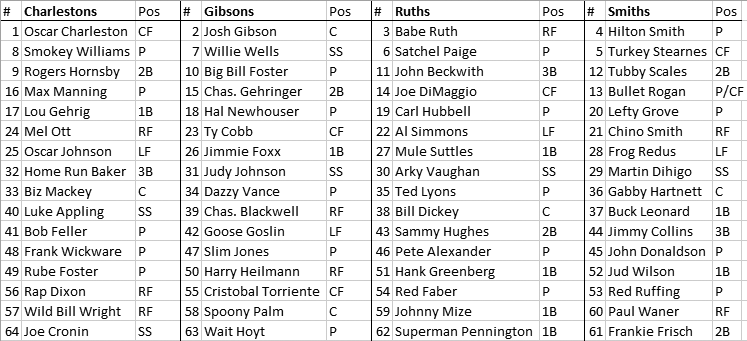
My dad played some Strat-O-Matic baseball as a kid, but he never did introduce it to my brothers or me for some reason. I'd been mildly curious about Strat for awhile, but when they released a set of Negro Leagues All-Stars back in 2009, I had to check it out. I ordered the board game, the Negro leagues card set, and a set of Hall of Famers. My then three year-old son was interested in rolling the dice for me for a little while, and I enjoyed getting to put some of the Negro leagues legends into action as I learned the basic game. The game went on the shelf for awhile, with the hope that my son would get into the gameplay more when he was a little older. We pulled it down last fall, and six year-old Henry was indeed a little more into it, and can find the results of each dice roll on the cards by himself now. My interest in the game was re-piqued, and I started getting curious about learning the advanced version of the game. So I decided to draft four teams made up of Negro leaguers and pre-integration Hall of Famers to learn with. The first step was choosing the pool of players. I decided to make the "league" split evenly between Negro leaguers and Hall of Famers, so chose the top two players at each position from each set, plus some extra pitchers and bench players, and went about drafting four teams. For the draft, I ignored which set the player came from, and ended up with what four all-star teams might have looked like between roughly 1900-1946 had the insanity of segregation not existed. Here's how the four teams (which I named for their respective first picks) shaped up (click to enlarge):


Much to the chagrin of my wife, I started rolling some games ("Why would you want to play by yourself?!") to try out some of the advanced rules. But then I started getting a little too into the results and how these players were performing against each other. In the tiniest of ways, it feels like righting the wrong of separating the best players from each other during their era. Next thing I knew, I had dreams of playing a full 154 game season for each team (a total of 308 games), partly for the fun of just playing the game, and partly to come up with some oh so satisfying stats from these guys playing together. It's a great way to fill the baseball void in the off-season. I'm about a quarter of the way there, and just took a long time tabulating the stats from the season so far, and figured I might as well share them here in case anyone else finds it enjoyable. (After I explained what I was doing, even my wife allowed she could see how it might be compelling to integrate the segregated era.)

The team results aren't particularly interesting since they are arbitrary teams, but so far, it seems I picked evenly. Here are the wins and losses:

Charlestons 21-18
Gibsons 20-19
Smiths 19-20
Ruths 18-21

More fun to me are the individual leaderboards. The league has been extremely high scoring, with teams each scoring around six runs a game. The average ERA is 5.21 and average OPS is .826. Without further ado: